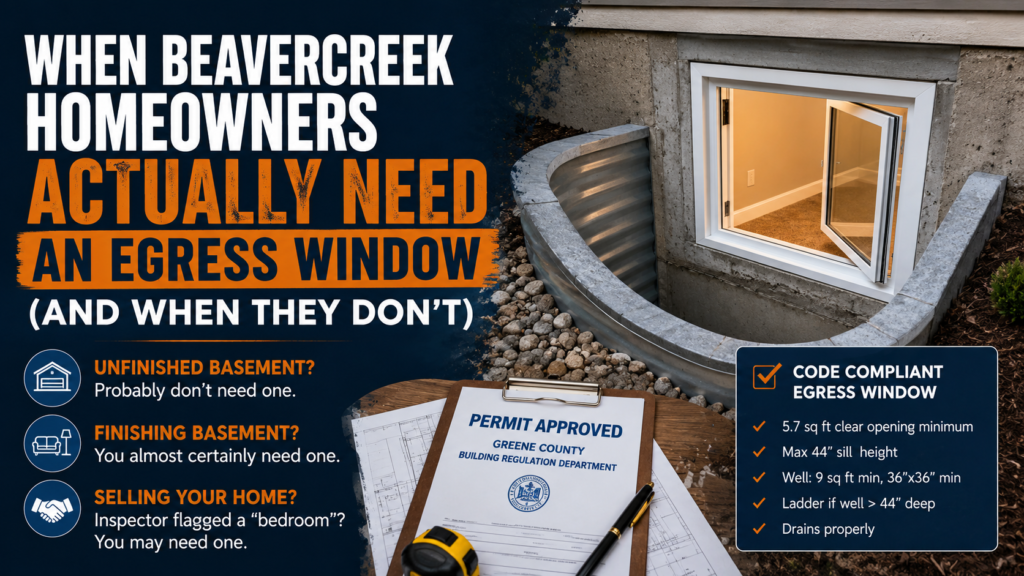
Most homeowners in Beavercreek don’t think about egress windows until one of three things happens: they decide to finish their basement, they list their home and the inspector flags a “bedroom” without one, or they read their kids’ lease agreement on a rental property and realize the basement bedroom isn’t legal.
The confusion is fair. Ohio’s residential code language is dense, local building departments interpret a few details differently, and contractors — even good ones — sometimes give answers that sound confident but skip the nuance. This post is the explainer we wish more Beavercreek homeowners had before they called us.
What an Egress Window Actually Is (and Why Ohio Code Cares So Much)
An egress window is an emergency escape and rescue opening sized so a person can climb out and a fully-equipped firefighter can climb in. That second part is what surprises people. The 5.7 square foot minimum opening size isn’t arbitrary — it’s based on the space needed for a firefighter wearing breathing apparatus and full turnout gear to enter through the window during a rescue.
That’s the principle behind Ohio’s adoption of the International Residential Code (IRC) Section R310. The state follows the IRC, and Beavercreek enforces it through the Greene County Building Regulation Department.
Here are the specific numbers, because every contractor conversation eventually comes back to them:
- Minimum net clear opening: 5.7 square feet (5.0 square feet for grade-floor openings)
- Minimum opening height: 24 inches
- Minimum opening width: 20 inches
- Maximum sill height: 44 inches above the finished floor
- Window well minimum area: 9 square feet
- Window well minimum width and projection: 36 inches each
- Ladder or steps required when the well depth exceeds 44 inches
One important catch most homeowners miss: the 20-inch and 24-inch minimums are clear opening dimensions, not the size of the window unit. A 20-inch-wide casement window doesn’t give you a 20-inch clear opening — the frame eats some of that. This is the single most common mistake we see when a homeowner buys a window from a big-box store thinking it’ll be code-compliant.
The Real Trigger Question: Do You Actually Need One?
The honest answer is: it depends on what you’re doing with the space. Three scenarios cover almost every situation we encounter in Beavercreek homes.
Scenario 1: You Have an Unfinished Basement and Plan to Keep It That Way
You probably don’t need one. Ohio code requires egress openings in basements that contain habitable space — bedrooms, family rooms, offices, exercise areas — but a basement used only for mechanical equipment, storage, and laundry is generally exempt. If your basement floods nothing but a furnace, a water heater, and some shelving, there’s no code requirement to add an egress window.
That said, plenty of Beavercreek homeowners install one anyway, for two reasons: natural light makes the space dramatically more usable, and it gives them the option to convert later without ripping out finished walls. If you’re 70% sure you’ll finish the basement eventually, installing the egress window before the finishing work is significantly cheaper than retrofitting after.
Scenario 2: You’re Finishing Your Basement to Add Living Space
You almost certainly need one. The moment you start framing walls to create a bedroom, a den, a media room, or a home gym in the basement, you’re creating habitable space, and Ohio code requires at least one emergency escape and rescue opening in any basement with habitable space — even if no one ever sleeps down there.
If you’re adding a bedroom specifically, the rule tightens: every sleeping room must have its own emergency escape opening. Two basement bedrooms means two egress windows. There’s no sharing.
We see homeowners try to skip this step regularly. The math seems compelling — an egress window installation in a poured concrete foundation runs $4,500 to $7,500 in this area, and that money looks like it could go toward better flooring or a nicer bathroom. But the rework cost is brutal. We’ve been called in twice this year to retrofit egress windows into already-finished basements where the original contractor didn’t pull permits or didn’t include them. In both cases, the homeowner paid for the egress window twice, the drywall and flooring twice, and the inspection twice.
Scenario 3: You’re Selling and the Inspector Flagged a “Bedroom”
This is the situation where most homeowners discover they have a problem. Your listing agent calls the basement room a bedroom because it has a closet and a door — and the buyer’s inspector confirms it can’t legally be marketed as one because there’s no compliant egress. The fix has to happen before closing, or the room gets re-labeled as a “den” and the appraisal drops.
If you’re planning to sell within 12 months and a basement bedroom is part of your home’s bedroom count, get an egress window installed before listing. The bedroom count materially affects appraised value in Beavercreek’s price band, and an unflagged bedroom is much stronger marketing than a “potential bedroom” with an asterisk.
Beavercreek-Specific Realities That Out-of-Town Guides Miss
Three things about installing egress windows in Beavercreek that you won’t find in generic IRC explainer articles:
- Beavercreek has a lot of poured concrete foundations from the 1970s and 80s. Cutting a window opening in a poured wall requires diamond-blade saw cutting through 8 to 10 inches of concrete, which is louder, dustier, and more expensive than cutting a block wall. Plan for a one-day cut, expect the crew to use water suppression, and warn your neighbors. A block foundation cuts faster and cheaper, but you have fewer of those in this area than you might think.
- Greene County requires permits and inspections, full stop. The egress window installation in a Beavercreek home requires a permit from the Greene County Building Regulation Department, and the inspection happens after the window is in but before the well is backfilled. If a contractor tells you they can skip the permit to save you money, that’s a serious red flag — and worse, the unpermitted work shows up on the disclosure when you sell.
- Ohio’s freeze-thaw cycles destroy poorly drained window wells. Standing water at the base of a window well freezes, expands, and pushes against the well wall — and against the window itself. The crack you see four years after installation usually traces back to drainage that wasn’t installed correctly. A proper installation ties the well drain into the existing foundation drainage or terminates it in a properly sized gravel sump. Skipping this step to save $400 on the install costs $4,000 later in foundation work.
How to Tell If You Got a Good Installation
After the contractor leaves, before you sign off, check these:
- The window operates freely from inside without keys, tools, or special knowledge
- The clear opening — not the window frame — meets the 5.7 sq ft minimum
- The sill is no more than 44 inches off the finished floor
- The well is at least 36 inches wide and projects at least 36 inches out from the foundation
- If the well is deeper than 44 inches, there’s a permanent ladder
- The well drains. Pour a few gallons of water in and watch where it goes. If it pools, you have a problem
- The window well cover (if installed) opens from inside without keys or force
If any of those check out wrong, the installation isn’t compliant — and you should not let the contractor close out the permit until they’re fixed.
The Cost Conversation
For a straightforward egress window installation in a Beavercreek home with a poured concrete foundation, plan for $4,500 to $7,500 all in. That covers permit, excavation, concrete cutting, window unit, window well, drainage, backfill, interior finishing of the opening, and inspection. Block foundations run slightly less. Older homes with stone or rubble foundations run significantly more — sometimes $9,000 to $12,000 — because the wall has to be carefully shored before cutting.
The cheaper quotes you’ll see ($2,500 to $3,500) usually skip one of three things: the permit, the drainage tie-in, or the structural header above the new opening. All three matter, and the savings disappear the first time you have a problem.
A Final Word on Timing
If you’re planning a finished basement, install the egress window first. It’s the messiest, dustiest, loudest part of the entire project, and you want it done before any drywall goes up. The dust from concrete cutting will find its way into every finished surface in the house if it’s done out of sequence — we’ve seen it ruin freshly painted ceilings two floors away.
For Beavercreek homeowners working through this decision and wanting a local contractor familiar with Greene County’s permitting process, Dream Big Contracting handles egress window installation in Beavercreek along with the basement finishing work that often follows. The right time to ask the question is before you’ve started framing — not after.