
 By Admin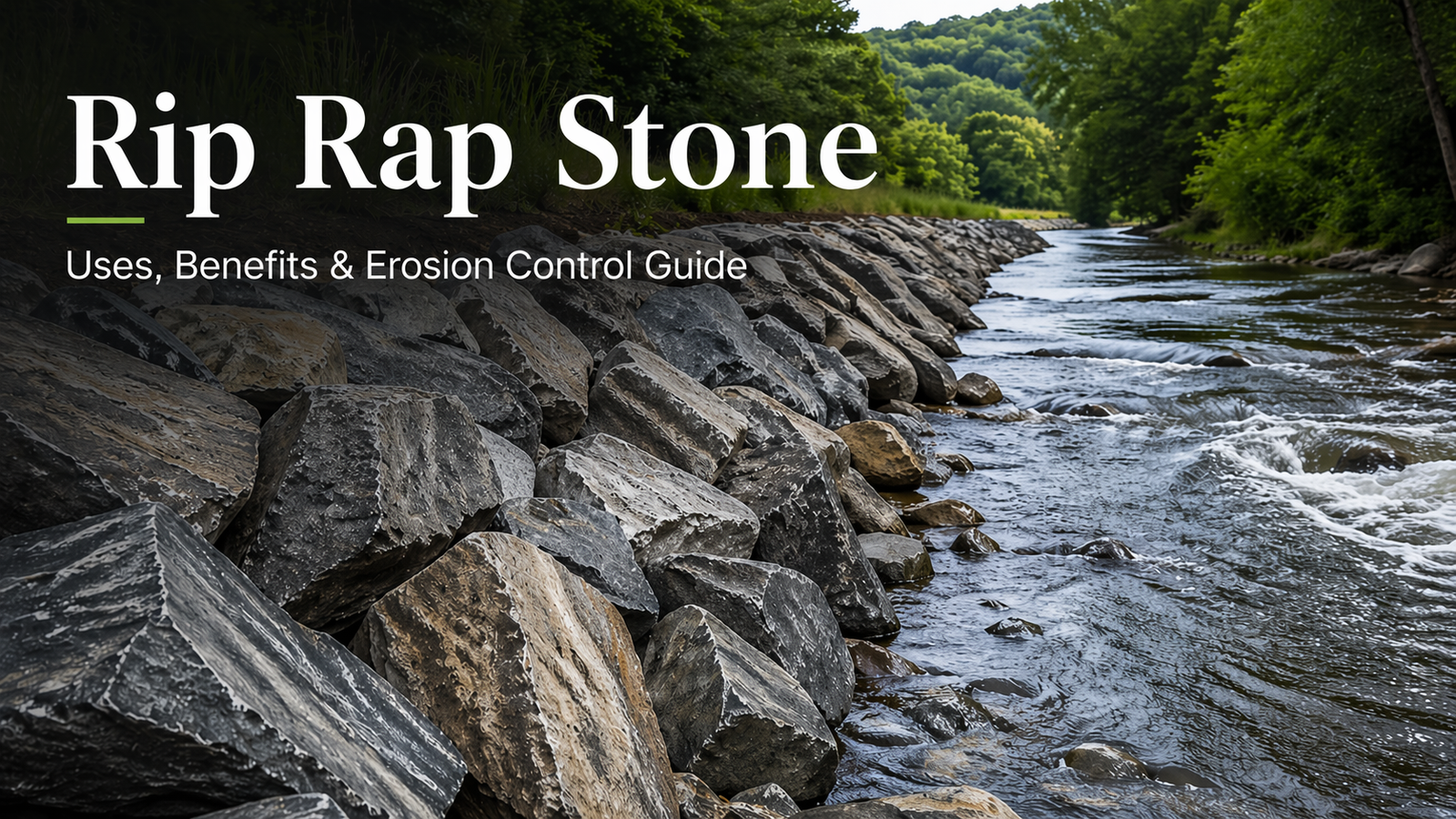
If you have ever seen a shoreline, streambank, culvert outlet, or roadside slope covered with big rough rocks, you were probably looking at rip rap stone. The standard industry spelling is usually riprap, but people search it a lot of ways — rip rap stone, rip-rap stone, or riprap rock. Same idea. And it’s one of those simple solutions that keeps showing up because, honestly, it works.
At its core, rip rap stone is a layer of large, loose, usually angular rock placed over soil to reduce erosion and protect vulnerable ground from moving water, runoff, wave action, or seepage. It is commonly used on streambanks, drainage channels, culvert inlets and outlets, bridge areas, slopes, and shorelines where vegetation alone may not be enough.
What Is Rip Rap Stone?
Rip rap stone is not decorative gravel. That’s the first thing to understand. It is an erosion-control material made of larger rock pieces that are chosen and placed so they can resist water forces and help protect the soil beneath them. In engineering guidance, riprap is often described as a permanent protective cover of loose, angular stone placed over a prepared slope or filter layer.
The rocks are usually:
- Large and heavy
- Angular rather than smooth
- Well graded, meaning mixed in a useful range of sizes
- Hard and durable enough to resist breakdown over time
- Placed over geotextile fabric, a granular filter, or both in many installations
That mix matters more than people think. Rip rap stone is not just dumped rock. Or at least, it shouldn’t be.
Quick Reference Table
| Area | How rip rap stone helps | Common note |
|---|---|---|
| Streambanks | Reduces bank erosion from flowing water | Often paired with a filter layer |
| Shorelines | Breaks wave energy and helps protect the edge | Common around lakes and coastal edges |
| Culvert outlets | Helps control scour where fast water exits | Thickness and stone size matter a lot |
| Drainage channels | Stabilizes side slopes and bottoms | Used where flow is too strong for grass alone |
| Bridge and roadway embankments | Protects slopes and abutments from erosion and scour | Often part of a larger hydraulic design |
The table above summarizes common applications repeatedly described in FHWA, EPA, and state erosion-control guidance.
How Rip Rap Stone Works
The idea is pretty practical. Water hits the rock layer first, not the bare soil. The stones absorb and spread out the force of flowing water or waves, which lowers the chance that the soil underneath will wash away. The spaces between stones also slow water a bit and reduce the direct attack on the bank or slope.
Angular rock is preferred because it tends to interlock better than rounded stone. That interlocking, along with the weight of the rock, helps the surface stay in place under runoff and concentrated flow. And beneath the stone, a filter layer or geotextile is often used so fine soil particles do not migrate out through the gaps. That hidden layer is a big deal… skip it, and a riprap section can fail from underneath.
Another reason rip rap stays popular is flexibility. Unlike a rigid concrete surface, a properly built riprap layer can adjust a bit to small shifts, minor undercutting, or settling and still keep doing its job. That makes it useful in changing water environments where perfect stability is not always realistic.
Why Rip Rap Stone Is So Widely Used
A lot of erosion-control methods look good on paper. Rip rap has stuck around because it checks several boxes at once.
Main benefits of rip rap stone
- Strong protection against erosion and scour
- Good performance in high-flow or wave-hit areas
- Long service life when designed correctly
- Lower maintenance than many temporary fixes
- More natural-looking than plain concrete in many landscapes
- Can work in places where vegetation cannot establish easily
And yes, it can look rugged in a nice way too. Not fancy. But solid.
Step-by-Step Basics of Installation
A real rip rap design should be sized for the site. Water depth, velocity, slope, wave action, soil conditions, and expected scour all influence the stone size and layer thickness. That is why professional guidance does not treat all riprap as one universal size.
Still, the usual installation process follows a familiar pattern:
1. Prepare the area
The slope or channel surface is cleared, shaped, and smoothed. Weak material may need to be removed and replaced.
2. Build the base
A filter fabric, stone filter, or both may be installed between the soil and the rip rap. This helps prevent soil loss through the rock layer.
3. Secure the edges
In many details, a toe trench or anchor area is used so the rip rap has a stable edge and is less likely to be undermined.
4. Place the stone
The rock should be hard, angular, weather-resistant, and well graded. It is placed to the required thickness with care so the filter layer is not damaged and large gaps are minimized.
5. Inspect it later
Rip rap is not “install and forget forever.” Guidance commonly recommends inspecting it at least periodically and after major storms, then repairing displaced stone or damaged fabric before a small problem turns into a bigger one.
Common Problems People Run Into
This is where things often go wrong. Not because rip rap is a bad solution — but because it gets simplified too much.
Mistakes to avoid
- Using stone that is too small for the water force
- Choosing smooth, rounded rock instead of angular stone
- Skipping the filter fabric or stone filter layer
- Failing to protect the toe, where undermining often starts
- Treating decorative landscape rock like engineered rip rap
- Ignoring repeated storm damage instead of checking the design
But here’s the thing: even good-looking rock can fail if the hydraulic conditions were underestimated. So appearance alone tells you almost nothing.
Rip Rap Stone vs. Regular Rock
Homeowners sometimes assume any large rock will do. Not really. Rip rap stone is selected for function, not just looks. Engineering and stormwater specifications commonly call for stone that is durable, angular, and graded in a way that helps it lock together and resist movement.
That’s why one project may use smaller rip rap around a drainage swale, while another needs much larger armor stone along a fast-moving channel or exposed shoreline. Same category. Very different performance demands.
FAQs About Rip Rap Stone
Is rip rap stone the same as gravel?
No. Gravel is much smaller and is usually not meant to handle the same erosion forces. Rip rap uses much larger stone, often with a designed gradation and base layer.
Can rip rap stone be used in residential landscaping?
Yes, especially near drainage paths, pond edges, swales, and slopes with runoff problems. But if water flow is serious, sizing should still be based on the site, not guesswork.
Does rip rap need maintenance?
Yes — not constant maintenance, but periodic checks matter. Most guidance recommends inspections after major storms and timely repairs when stones shift or underlayers are exposed.
Final Thoughts
Rip rap stone may look simple, and in a way it is. Big rocks. Smart placement. Solid protection. But behind that simple appearance is a method that has been used for decades in highways, waterways, stormwater systems, and shoreline work because it helps control erosion, reduce scour, and protect slopes where softer solutions can fail.
So if you are researching rip rap stone for a project, think beyond the rock itself. Think about water, slope, filter layers, toe protection, and long-term maintenance. That’s the real story. And that’s usually what separates a rip rap installation that lasts… from one that starts sliding after the next hard storm.