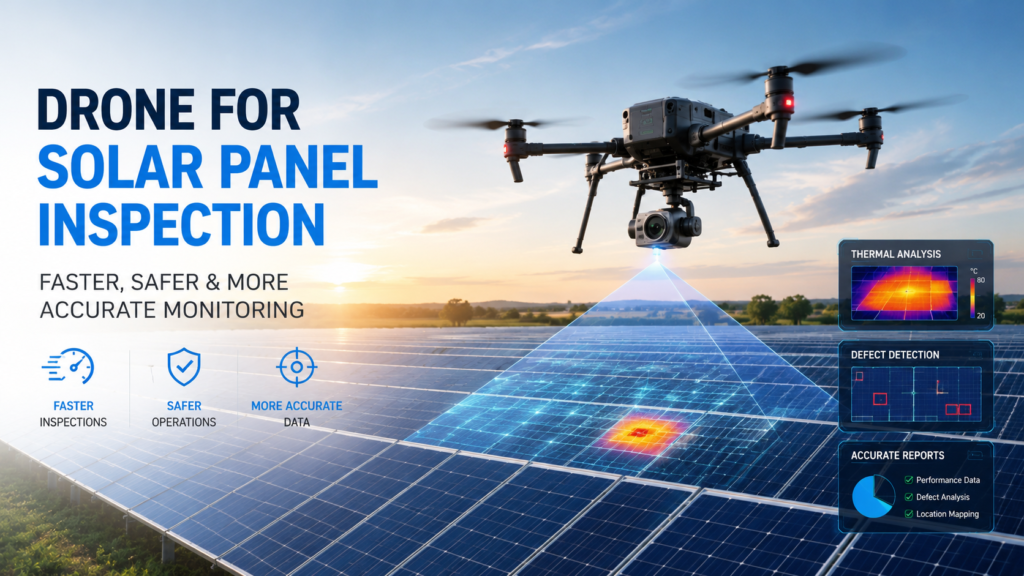
The solar energy industry is expanding rapidly as businesses and governments invest in renewable power solutions. With the increasing number of solar farms and rooftop solar installations, maintaining peak panel performance has become more important than ever. Traditional inspection methods often require manual labor, scaffolding, and significant downtime, making the process costly and time-consuming. This is where a drone for solar panel inspection is transforming the industry by providing faster, safer, and more accurate monitoring solutions.
Drone technology has revolutionized asset inspection across multiple industries, from energy to infrastructure. Similar to how bridge drone inspection improves structural monitoring and safety, drones are now helping solar operators detect faults, optimize efficiency, and reduce operational risks.
The Growing Need for Solar Panel Inspection
Solar panels are constantly exposed to harsh environmental conditions such as dust, dirt, rain, heat, and storms. Over time, these factors can lead to:
- Cracks in solar cells
- Hotspots and overheating
- Loose electrical connections
- Dust accumulation and shading
- Water ingress and corrosion
- Reduced power generation
Even a small defect can significantly impact energy production and reduce the overall return on investment. Large solar farms containing thousands of panels make manual inspections difficult and inefficient. This has increased the demand for advanced solutions like a drone for solar panel inspection that can quickly scan and analyze solar assets with precision.
How Drones Improve Solar Panel Inspection
Drones equipped with thermal imaging cameras, high-resolution sensors, and AI-powered analytics can inspect solar installations within a fraction of the time required by traditional methods. These drones fly over the solar array, capture detailed data, and identify performance issues in real time.
1. Faster Inspection Process
Traditional solar panel inspections may take days or even weeks for large-scale facilities. Technicians often need to walk through extensive solar fields and manually examine each panel.
A drone for solar panel inspection can cover vast areas in just a few hours. Automated flight paths allow drones to inspect hundreds or thousands of panels quickly and consistently. This speed minimizes downtime and ensures faster maintenance decisions.
For utility-scale solar farms, rapid inspections are critical to maintaining uninterrupted energy production.
Enhanced Safety for Inspection Teams
Worker safety is one of the biggest concerns in solar maintenance. Rooftop solar systems, elevated structures, and remote solar farms can expose workers to risks such as falls, heat stress, and electrical hazards.
Using drones significantly reduces the need for technicians to physically access dangerous areas. Operators can safely control inspections remotely while collecting accurate visual and thermal data.
The same safety advantages are seen in bridge drone inspection, where drones eliminate the need for workers to climb difficult structures or operate in hazardous traffic environments. In both industries, drones help reduce workplace accidents and improve operational safety standards.
Thermal Imaging for Accurate Fault Detection
One of the biggest advantages of drone inspections is the use of thermal imaging technology. Infrared cameras detect temperature variations across solar panels, helping identify hidden issues that are not visible to the naked eye.
A drone for solar panel inspection can easily identify:
- Hotspots caused by damaged cells
- Faulty bypass diodes
- Electrical imbalances
- Module degradation
- Overheating components
Thermal data allows maintenance teams to pinpoint exact problem areas and address them before they become major failures.
This level of accuracy improves maintenance efficiency while preventing costly energy losses.
Reduced Operational Costs
Manual inspections involve labor costs, equipment rentals, and extended inspection times. Large facilities may also require shutdowns during maintenance activities, leading to reduced power output.
Drones help reduce these costs by streamlining the inspection process. Since inspections are faster and more automated, fewer workers and less equipment are required.
A drone for solar panel inspection also helps detect minor issues early, preventing expensive repairs and extending the lifespan of solar assets.
Over time, predictive maintenance enabled by drones can significantly improve operational profitability.
Improved Data Collection and Reporting
Modern inspection drones do more than capture images. They collect comprehensive geospatial and thermal data that can be processed through advanced analytics software.
Inspection reports generated by drone systems often include:
- High-resolution aerial imagery
- Thermal heat maps
- Defect location mapping
- Performance analysis
- Maintenance recommendations
This digital approach creates accurate inspection records and simplifies long-term asset management.
Just as bridge drone inspection uses data analytics for structural health monitoring, solar drone inspections provide actionable intelligence that improves decision-making and maintenance planning.
Scalability for Large Solar Farms
As solar energy projects continue to grow in scale, efficient monitoring becomes increasingly challenging. Large utility-scale solar farms can span hundreds or even thousands of acres.
A drone for solar panel inspection offers unmatched scalability. Automated drones can perform routine inspections across massive installations without disrupting operations.
This capability allows energy companies to maintain consistent inspection schedules while reducing manpower requirements.
Scalable drone inspections are especially valuable in remote locations where manual access is difficult and time-consuming.
AI and Automation in Solar Inspections
Artificial intelligence is making drone inspections even more advanced. AI-powered software can automatically analyze thermal and visual data to detect anomalies with greater speed and accuracy.
Machine learning algorithms help identify patterns related to panel degradation, energy loss, and recurring faults. This predictive capability allows maintenance teams to resolve problems before they impact system performance.
A modern drone for solar panel inspection integrated with AI can deliver real-time insights and automated reporting, helping operators improve maintenance efficiency and maximize energy output.
Environmental and Operational Benefits
Drone inspections support sustainability goals by reducing the environmental impact of maintenance activities. Since drones require minimal equipment and fewer vehicles, they lower fuel consumption and reduce carbon emissions.
Additionally, faster inspections mean less operational disruption for solar facilities.
The use of drones also aligns with broader digital transformation initiatives in infrastructure management. Similar to bridge drone inspection, solar drone technology represents a smarter and more sustainable approach to asset monitoring.
The Future of Solar Panel Monitoring
The future of solar energy maintenance is increasingly data-driven and automated. Drone technology will continue evolving with advancements in:
- AI-powered defect recognition
- Autonomous flight systems
- Cloud-based analytics
- Real-time monitoring platforms
- Digital twin integration
These innovations will further improve the efficiency and reliability of solar infrastructure management.
As renewable energy adoption grows globally, the demand for a reliable drone for solar panel inspection solution will continue rising across utility providers, industrial facilities, and commercial solar operators.
Conclusion
Drones are transforming the way solar infrastructure is monitored and maintained. By delivering faster inspections, enhanced safety, precise thermal analysis, and cost-effective operations, drone technology is becoming an essential tool for the renewable energy sector.
A drone for solar panel inspection enables operators to detect faults early, improve energy efficiency, and reduce maintenance costs while ensuring long-term asset performance. The technology also mirrors the advantages seen in bridge drone inspection, where drones enhance safety, accuracy, and operational efficiency in infrastructure monitoring.
As the solar industry expands, drone-based inspection systems will play a critical role in supporting reliable, scalable, and sustainable energy production for the future.